Is the garbage collection fee included in the maintenance fee?
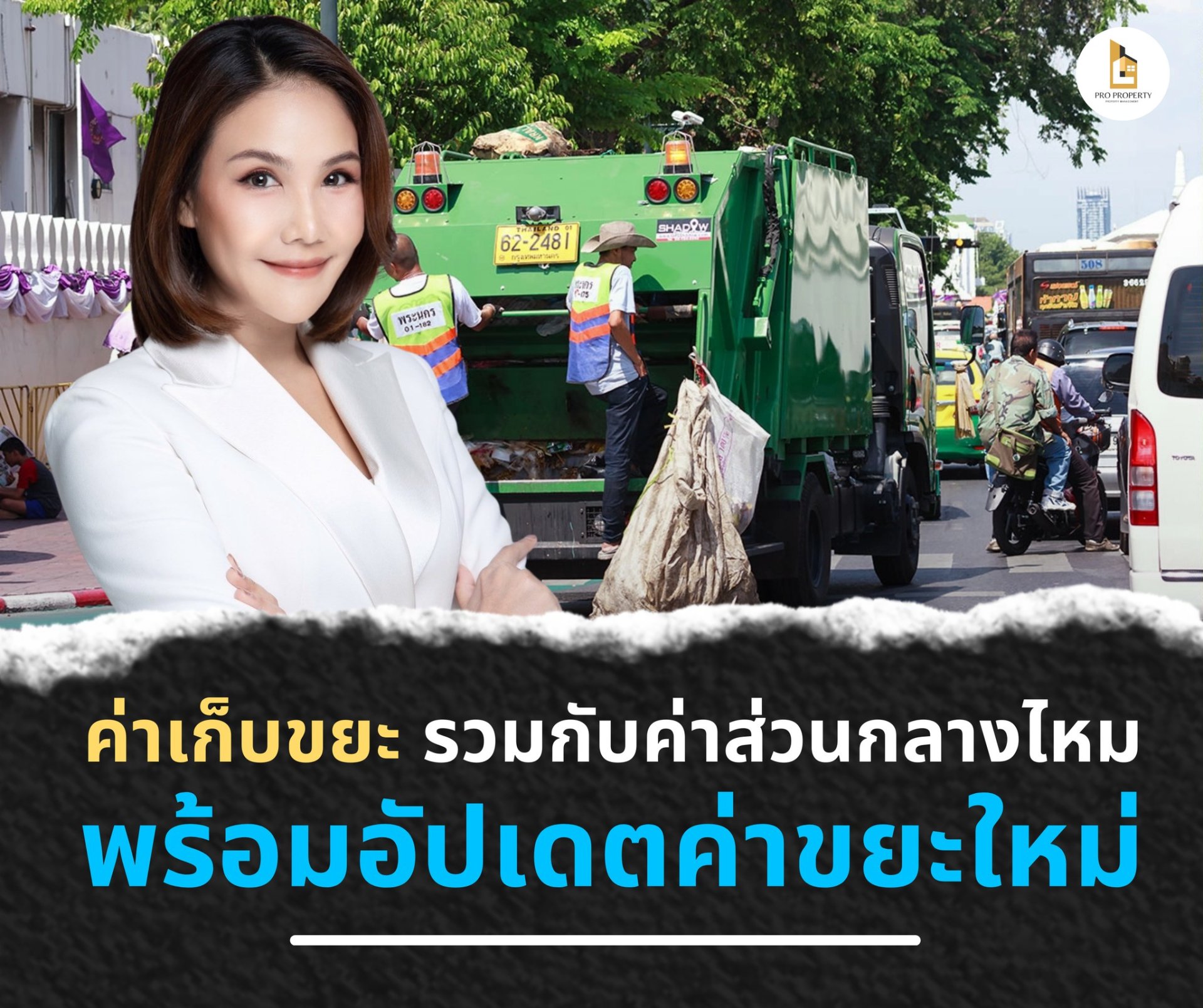
Is the garbage collection fee included in the common area fee? This is a question that often puzzles many people: why is there an additional "garbage collection fee" when they have already paid a substantial common area fee in advance?
Before the frustration mounts, let’s clear up the confusion regarding garbage collection fees and look at the updated rates.
___________________________________________
Garbage collection fees are not included in the common area fee.
Since the garbage collection fee is separated from the common area fee, many are confused as to why an extra payment is required when the juristic person (property management) already collects common area fees.
The residents required to pay this additional garbage collection fee are those living in housing developments—whether detached houses, townhouses, or home offices across all price ranges—or those who built homes on their own private land. All of them are required to make this additional payment.
Crucially, the collection is carried out by district officials or local administrative organizations (SAO/TAO); the money does not go into the pockets of the juristic person or the housing development developer.
In contrast, condominium residents do not have to pay an extra garbage collection fee, as this service is already included in the common area fee determined and managed by the juristic person.
However, some housing developments do include the garbage collection fee within the common area fee. Therefore, prospective buyers should clarify this matter with the juristic person before deciding to purchase a home.
___________________________________________
Updated Garbage Collection Fees: A Threefold Increase if Waste Is Not Separated
Bangkok Metropolitan Administration (BMA) Garbage collection fees will increase threefold; however, households that sort their waste will see the rate reduced to 20 baht per month. This change, effective October 2025, stems from an amendment to the Bangkok Metropolitan Administration (BMA) ordinance regarding service fees for sewage and solid waste management under public health laws.
The ordinance mandates that owners or occupants of buildings or premises generating sewage or solid waste must pay prescribed management fees, comprising:
1. Sewage collection and disposal fees (septic tank and grease trap pumping)
Charged at a rate of 600 baht per cubic meter per service (300 baht for collection/transport and 300 baht for disposal).
2. General solid waste collection and disposal fees (categorized into monthly and occasional services)
2.1 Monthly general solid waste collection and disposal fees
– For waste volumes not exceeding 20 liters per day: The fee is 60 baht per month (30 baht for collection/transport and 30 baht for disposal).
However, if waste is sorted and the household registers according to BMA criteria, the fee remains at the previous rate of 20 baht per month (10 baht for collection/transport and 10 baht for disposal).
– For waste volumes exceeding 20 liters per day but not exceeding 1 cubic meter per day: The fee is 120 baht per 20 liters.
– For waste volumes exceeding 1 cubic meter per day. A fee of 8,000 Baht per cubic meter applies (3,250 Baht for collection and transport; 4,750 Baht for disposal).
2.2 Fees for the occasional collection, transport, and disposal of general solid waste:
– For waste volumes not exceeding 500 liters: 255 Baht per collection (125 Baht for collection and transport; 130 Baht for disposal).
– For waste volumes exceeding 500 liters but not exceeding 1 cubic meter: 370 Baht per collection (180 Baht for collection and transport; 190 Baht for disposal).
– For waste volumes exceeding 1 cubic meter: Charged by unit at 495 Baht per unit (245 Baht for collection and transport; 250 Baht for disposal).
Occasional waste collection services include:
– Bulky waste (e.g., mattresses, tables, beds, scrap wood, electrical appliances, sofas, chairs, etc.): You may call the local District Office to request service, or the District Office may issue an announcement scheduling a collection day for bulky waste (no fee).
– Large quantities of tree branches: You may call to request a service for the collection and transport of branches and leaves from residences.
– Construction debris from residences (e.g., stone, mortar, concrete, ceiling panels): You may call to request a service for the collection and transport of construction debris.
Service requests can be made at the Cleansing and Parks Section. District Office
3. Fees for the collection, transport, and disposal of infectious waste
3.1 Monthly fees for the collection, transport, and disposal of infectious waste
– For waste volumes not exceeding 13 liters per day or weights not exceeding 2 kilograms: 780 Baht per month (300 Baht for collection/transport and 480 Baht for disposal).
– For waste volumes exceeding 13 liters per day or weights exceeding 2 kilograms: Charged by unit at 480 Baht per unit (300 Baht for collection/transport and 480 Baht for disposal).
3.2 Fees for the collection, transport, and disposal of infectious waste (occasional service)
For occasional service, the collection and transport fee consists of two components: a service fee of 3,000 Baht per trip; if the distance exceeds 10 kilometers, an additional 15 Baht per kilometer is charged, provided the total does not exceed 5,000 Baht.
Regarding the collection and transport fee: for volumes up to 100 liters or weights up to 15 kilograms, the charge is 75 Baht per trip. For volumes exceeding 100 liters or weights exceeding 15 kilograms, the charge is calculated by unit (every 100 liters or every 15 kilograms) at 75 Baht per unit.
For the disposal fee (occasional service): for volumes up to 6.5 liters or weights up to 1 kilogram, the charge is 8 Baht per unit.
___________________________________________
What can you do to avoid paying three times the waste collection fee?
To encourage residents to reduce and sort waste at the source, the Bangkok Metropolitan Administration (BMA) has launched the "No Mixed Dumping: Sort Waste, Lower Fees" project. This initiative invites the public to help protect the environment by reducing, sorting, and repurposing waste. These actions reduce the volume of waste requiring BMA disposal, thereby lowering the associated waste management fees.
Waste is categorized into four groups:
1. Recyclable waste: Includes aluminum cans, water bottles, glass bottles, notebooks, books, steel cans, pump bottles/opaque plastic bottles, newspapers, and cardboard boxes/parcel boxes.
Disposal method:
1) Empty out any liquids or food scraps (if present) and rinse the items clean.
2) Collect the items in a clear bag or a bag that allows the contents to be seen.
3) Sell or donate the items.
4) If disposing via the BMA: Tie the bag securely. If using a black bag, write "Recyclable Waste" on it or attach a label/symbol indicating this. Place it at the designated collection point and wait for the District Office's scheduled pickup.
2. Food waste: Includes fruit peels, vegetable scraps, and leftover food.
Disposal method:
1) Drain off liquids and keep only the solid food scraps (remember to pour out soups or curries first).
2) Repurpose the waste by making compost or using it as animal feed.
3) If disposing via the BMA: Place the waste in a green bag. ...or use a bag that allows the contents to be seen; tie the bag shut and place it at the designated disposal point.
4) Wait for collection according to the schedule set by the District Office.
3. General waste: Includes snack wrappers, tissues/wet wipes, coffee cups, food bags (curry bags), toothpaste tubes, refill pouches, foam containers, plastic bags, fabric scraps, and disposable diapers.
Disposal method:
1) Collect the waste in a bag and tie it shut.
2) Dispose of it in a trash bin or at a designated disposal point on the days and times specified by the District Office.
4. Hazardous waste: Includes batteries, light bulbs, gas canisters/spray cans, broken charging cables, and expired medicines.
Disposal method:
1) Collect the waste in a clear bag or a bag that allows the contents to be seen.
2) If using a black bag, write a message, attach a label, or mark it with a symbol indicating "Hazardous Waste."
3) Dispose of it at designated points or wait for collection according to the schedule set by the District Office.
Registration is divided into two formats:
1. Individual registration
For general households generating no more than 20 liters or 4 kilograms of waste per day. This group includes detached houses, housing estates, and condominiums/flats that do not have a juristic person (management entity).
Homeowners or tenants wishing to participate in the project can register themselves via the "BKK WASTE PAY" application or website. Those without a smartphone may register with the fee collection staff or at the District Office responsible for their area.
Required information for registration includes: an 11-digit House ID, full name, telephone number, and a photograph of the sorted waste. (Food waste, recyclable waste, hazardous waste, and general waste)
During the first year, registered households will receive bags specifically for food waste. Additionally, the system includes random inspections of waste sorting practices every three months.
2. Group Registration
This applies to housing estates, residential condominiums with a juristic person (management entity), and communities recognized under Bangkok Metropolitan Administration regulations, provided that waste generation does not exceed 20 liters per day per house or unit.
The local District Office will invite the juristic person to a meeting to explain the details and guidelines for setting up a centralized collection point for the four sorted waste categories. They will also outline the registration process and required documentation—such as the resolution from the residents' meeting, the 11-digit House ID for every unit, and proof of waste utilization.
For more information, please contact the Bangkok Metropolitan Administration’s Department of Environment at 02-203-2936-7 or the Cleansing and Parks Section of any of the 50 district offices.
___________________________________________
Thanks to DD Property for this useful information.


